Market Demand
The 30% That Never Was: How Flex’s Most Famous Number Drifted
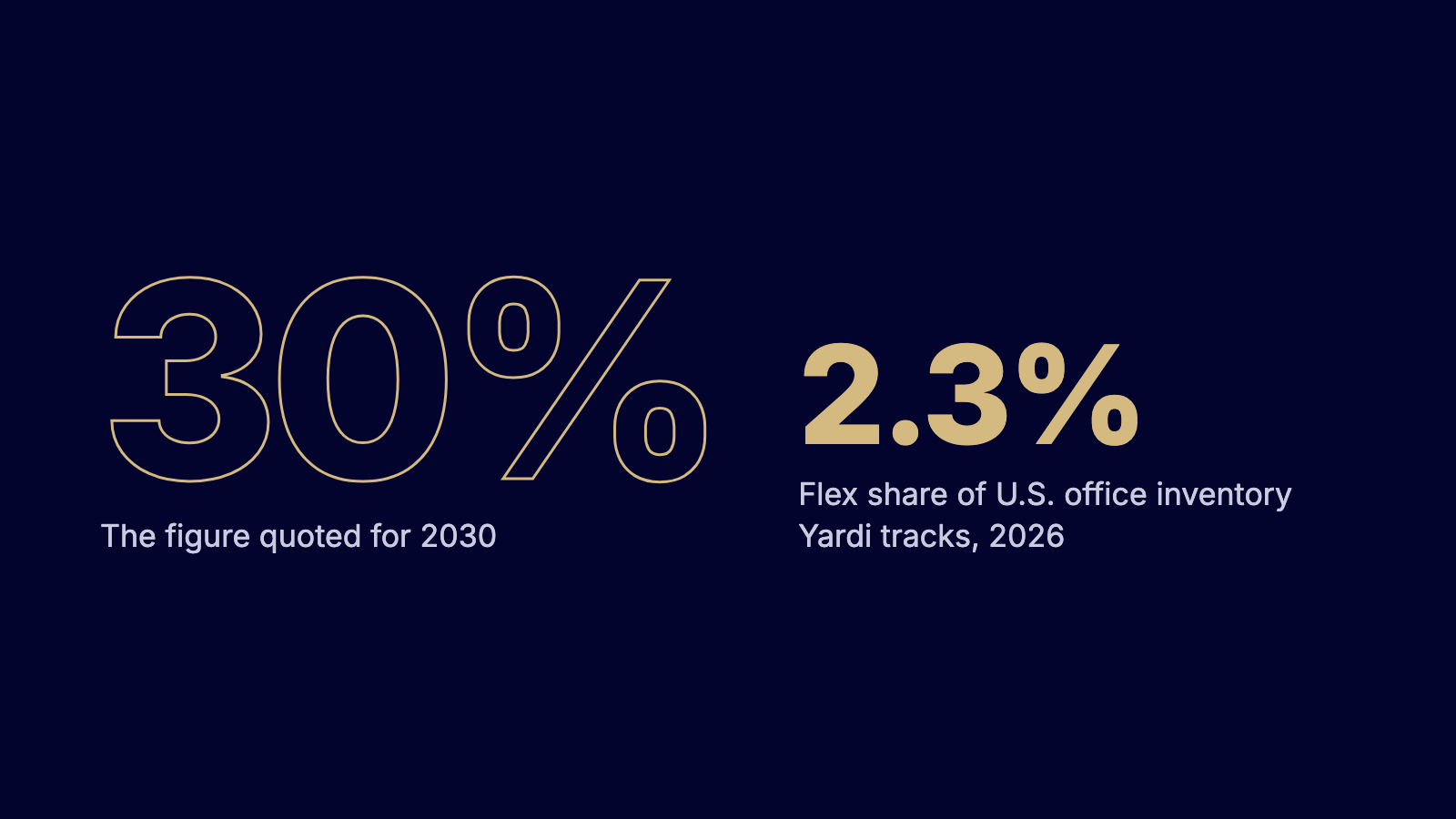
In 2016 it described how much of a company’s own real estate could be flexible. A decade of retelling turned it into a forecast for all commercial real estate. By Yardi’s 2026 count, flex is about 2.3% of the U.S. office inventory it tracks.
In this article
The number in the pitch deck
Sit in enough landlord meetings and you will hear it: flexible space will be 30% of the office market by 2030. It appears in operator pitch decks, broker presentations and press releases. It is offered as the reason a floor should become flex now, before the market catches up.
With 2030 a little over three years away, the number is worth following back to where it came from. It turns out to be several different claims that happen to share one figure. Each retelling kept the 30% and changed what it was a percentage of.
From a portfolio to the whole market
- 2016JLL, Workspace, Reworked 1
“Up to 30 percent of corporate real estate portfolios will comprise flexible space by 2030.”
The subject is the occupier: how a company might split its own real estate between long-term leases and flexible space.
- 2017JLL, Bracing for the Flexible Space Revolution 2
Flex “could rise to 30 percent by 2030,” from less than 5% of office inventory.
The subject moves to the market, and the footnote counts “flexible workspace and shared amenity spaces,” with independent operators at about 2% of U.S. inventory.
- Nov 2017Conference recap 3
“30% of office space will be flexible by 2030.”
Within months, the portfolio framing is gone.
- 2018JLL Research, Melbourne 4
Flexible space “would equal to 30% of total office stock in some markets.”
A qualifier, “in some markets,” that later retellings dropped.
- 2019MBA Newslink 5
“30 percent of the U.S. office market will be flexible space by 2030.”
The denominator is now the whole national market.
- 2019
- 2026JLL, Global Workspace Association keynote 8
The 30% “was a demand number, not a forecast of how much flex space would be built.”
As reported: occupiers were asked how they wanted their portfolios split, and they said 30% flex.
- 2026International Workplace Group 9
“30% of all commercial real estate will be flexible workspace by 2030.”
The denominator grows past office to every commercial property type.
There is simply not enough available office space to support this supply without even more drastic changes in tenant behavior.
Julie Whelan, CBRE, on the 30% figure, September 2019 6
Where flex actually sits
Yardi’s 2026 count puts flexible space at about 2.3% of the U.S. office inventory it tracks, which excludes landlord-run spec suites.8 That is close to the roughly 2% JLL counted for independent operators in 2017, and the just under 2% CBRE measured in 2019.2 7 Some markets run higher: the same article cites London at about 10%. Even there, the number sits at a third of the famous figure.
None of this means flex is failing. It means the 30% did not start as a measure of market supply. A company telling a broker it would like 30% of its own space to be flexible is a real and useful signal about occupier demand. It is a different statement from 30% of all office buildings becoming flex.
Why only two percent got built
Two percent is a share of something enormous, and the industry built all of it against the formula, not with its help. So why is it still only two percent?
Because the formula that values a building is antiquated, and it is the thing underwriters and landlords care about most. It was built around the lease, decades ago: how many years, how strong the tenant’s credit, how the rent steps up. Run it over a coworking floor and it loses twice. If an operator signs a lease, the appraiser sees a lease, but from a tenant the formula scores as weak credit, so the same rent adds less to the building’s value than it would from a tenant on ten years. If there is no lease, because the owner runs the floor or hires an operator under a management agreement, the income barely counts at all.12 Either way the dozens of paying members behind the floor never enter the math. Most landlords are managing toward a sale or a refinance a few years out, and what lifts the number at that moment is tenants the formula likes: long terms, strong credit. So landlords routinely reject coworking operators who are willing to sign a lease, not because the rent is lower, but because the formula scores the tenant down. On paper the floor is worth less than it earns, so the capital that would build the next one never shows up.
It does not matter much who runs the floor: an operator under a management agreement, an entrepreneur who signs the lease, or an owner who leases it to a company of its own, under its own brand or a franchise. In every case the rent roll shows one line where there are dozens of paying members.
What the rent roll sees
One line, scored on term and credit like every other line.
Suite 200, from the inside
Forty businesses on one line of the rent roll, and the tenants the other suites are made of.
And it misses what owners have started to notice.
A vibrant coworking space is the front door to the building. Companies arrive on a desk, grow, and graduate to a traditional lease on another floor in the building.
The floor’s own income may never count. The leases it feeds upstairs do.
| Seat | In their own words |
|---|---|
| The appraiser | The office industry “has gotten used to five, seven and ten year leases,” so short agreements are “difficult to value and monetize.” Giovanni Palavicini, 2025.11 |
| The lender | Management-agreement income is viewed as “less stable” than lease revenue. JLL, 2026.10 |
| The owner | “We have assumed no income” from a floor it chose to keep running as coworking. City Office REIT, 2024.12 |
| The occupier | The first reason for choosing flex: avoiding capital expense. CBRE, 2025.13 |
Increasingly, owners and operators have stopped waiting for the formula to catch up, and flex floors are opening in buildings across the country. The contrast is below. And an owner who runs the floor itself and earns that multiple can still see little of it in the appraisal, because it arrives as business income, not rent. The cash is real. The formula is not built to count it.
A thriving coworking business inside a building may be the secret ingredient in its next valuation. The underwriters don’t see it yet, and neither do most landlords. The ones who do are building for the future.
Frequently asked questions
Where did the 30% flex by 2030 figure come from?
It traces to JLL research in 2016, which forecast that up to 30% of corporate real estate portfolios could be flexible by 2030. It was a statement about how companies would hold their own space, not about how much of the office market would become flex.
How much of the U.S. office market is flexible space today?
Yardi's 2026 count puts flex at about 2.3% of the U.S. office inventory it tracks, which excludes landlord-run spec suites. That is close to the roughly 2% JLL itself counted for independent operators in 2017. Definitions vary, so any share depends on what is counted as flex.
Did any major broker forecast less than 30%?
Yes. In 2019 CBRE published three scenarios for 2030 at 6.5%, 13.3% and 22.2% of office space, all below 30%.
What should you use instead of a national share?
The demand within the building's own trade area, the realistic pricing of competing operators, and the share of the building flex can occupy before value is affected. JLL's April 2026 sale data shows buildings above about 17% flex historically saw value impairment, while CBRE's 2020 analysis put the line at 30%.
If the demand is real, why has so little flex been built?
Because building valuation still prices a lease, not a business. Appraisal and lending were built around a term of years and a tenant's credit, so a floor of small companies on short agreements reads as risk and its income gets little credit in the building's value, sometimes none. A coworking floor appears on the rent roll as one tenant where there are dozens of paying members.
Does it matter whether the owner runs the floor, hires an operator, or leases to a coworking business?
Not to the formula. Under a management agreement there is no lease to count. An entrepreneur on a lease counts as one tenant. An owner's own operating company counts as one lease to itself, whether under its own brand or a franchise. In every case the income arrives as memberships, and the old valuation method has nowhere to put that.
How quickly does a flex floor stabilize, and what does it earn?
Across the industry, a stabilized flex floor brings in roughly two and a half to five and a half times the rent on the same space, depending on market rents: the lower the market rent, the higher the multiple. Smaller floors reach 90% occupancy in about a year; larger ones take two to four. And an owner who runs the floor itself and earns that multiple can still see little of it in the appraisal, because it arrives as business income, not rent. The cash is real. The formula is not built to count it. Traditional office, by comparison, sits more than twenty percent vacant nationally.
Is a coworking operator a good tenant for a building?
On paper it is treated like any other tenant. In practice a vibrant coworking space works as the building's front door: companies arrive on a desk, grow, and graduate to a traditional lease on another floor in the building. Owners who turn away an operator willing to sign a standard lease are usually reading the form, not the floor.
Sources
- FMLink, "Major transformation of workspace and real estate explored in JLL report" (JLL, Workspace, Reworked), November 11, 2016↩
- JLL, "Bracing for the Flexible Space Revolution," 2017, as reproduced in Servcorp Limited Annual Report 2017, p. 8-9↩a ↩b
- Allwork.Space, "The Future of the Workplace: 12 Takeaways from the Office Evolution Conference," November 2017↩
- JLL Research, "Melbourne's flexible space stock: 30% by 2030?", October 29, 2018↩
- MBA CMF Newslink, "'Healthy Runway' for Flexible Office Space," February 7, 2019↩
- CBRE, press release on the U.S. flexible office sector, September 12, 2019↩a ↩b
- CBRE Research, "Let's Talk About Flex: The U.S. Flexible Office Market in 2019"↩a ↩b
- Allwork.Space, Jamie Russo, "What JLL and Yardi's Latest Numbers Tell Us About Flex Growth, Landlords, and Enterprise Tenants," September 10, 2026↩a ↩b ↩c
- International Workplace Group press release via Allwork.Space, September 25, 2026↩
- JLL Research, "The Flexible Office Space Imperative," April 2026, pp. 9-10↩a ↩b
- Giovanni Palavicini, in "Landlords vs. Operators: What's Holding Flex Office Back?" (video), February 5, 2025↩
- City Office REIT, Q4 2023 earnings call, February 22, 2024 (transcript via MarketBeat)↩a ↩b
- CBRE, 2025 Americas Office Occupier Sentiment Survey↩
- Yardi Kube, "Urban vs. Suburban Coworking 2026," July 2026↩
Members & Margins
The people and the business of the coworking model.
Ideas, stories and research for anyone who wants to understand both the members in the room and the margins that keep it open. Free.